

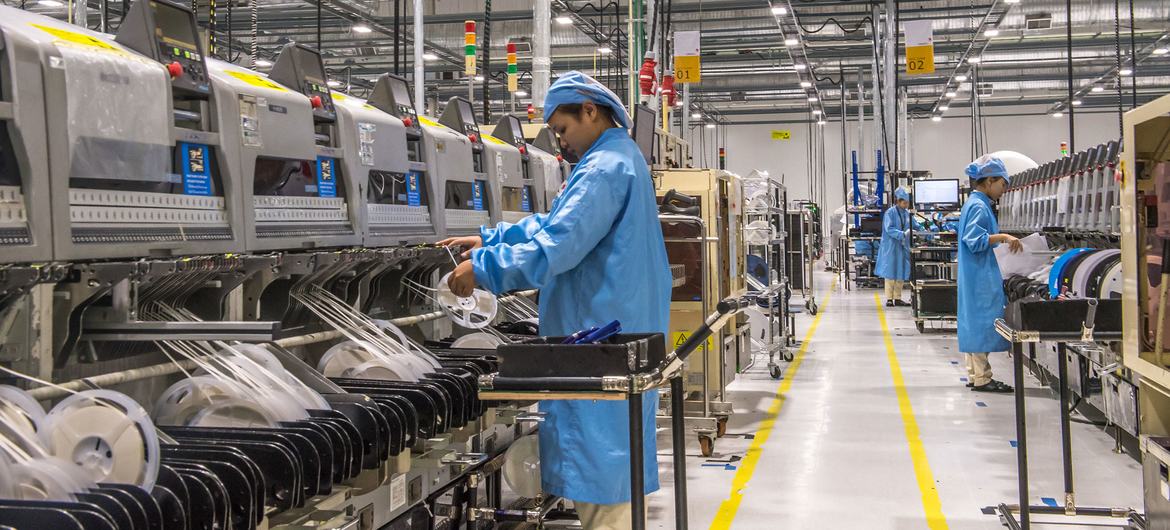
Since the 19th century, industrialisation has reshaped societies—creating jobs, boosting productivity, and lifting millions out of poverty. Yet it has also fuelled environmental degradation, polluted air and water, and accelerated the climate crisis now threatening communities worldwide.
According to the United Nations Industrial Development Organization (UNIDO), this destructive trajectory is not inevitable. With the right policies, technologies, and partnerships, industrial development can be inclusive, resilient, and environmentally sustainable.
Speaking at the Global Industry Summit in Riyadh, Fatou Haidara, UNIDO’s Deputy Director-General for Global Partnerships and External Relations, explained how the agency’s mission has evolved as it approaches its 60th anniversary.
From Pollution to Transformation
When UNIDO was founded in 1966, industry was widely viewed as a major polluter and industrial policy carried negative connotations. Today, Haidara said, industrialisation is understood as a systemic process—from policymaking and institutional capacity-building to supporting small and medium-sized enterprises (SMEs).
This complexity means no single actor can succeed alone.
“The crucial element is partnerships,” she said, highlighting collaboration with governments and the private sector to create the right conditions for sustainable investment and modern technologies.
At the heart of UNIDO’s work lies a dual imperative: protect the planet while lifting as many people as possible out of poverty.
Supporting Development Amid Conflict
Unlike many institutions, UNIDO continues operating even in conflict-affected countries such as Sudan. Haidara stressed that these are precisely the situations where development support is most needed.
By working remotely with governments on industrial strategies and long-term planning, UNIDO helps lay the groundwork for recovery—even when direct field operations are impossible.
Tailored Climate-Smart Industrial Strategies
Environmental sustainability is central to UNIDO’s approach, but Haidara emphasized that there is no one-size-fits-all solution.
- In some countries, the priority is access to energy
- In others, it is decarbonising heavily polluting industries
- Elsewhere, the focus may be energy efficiency or clean technologies
Climate considerations are embedded across all strategies, adapted to each country’s development stage and industrial profile.
Why UNIDO—and the UN—Still Matter
Responding to critics who question the relevance of UN institutions, Haidara argued that the UN is more necessary than ever.
“We are living in a rapidly changing world facing multiple crises. The UN is a neutral, multilateral platform where countries can talk to each other.”
UNIDO’s unique strength, she added, lies in its ability to integrate economic growth, environmental protection, and social inclusion, drawing on six decades of global experience and best practices.
“We are not a humanitarian institution,” Haidara concluded, “but we remain on the side of the people.”