


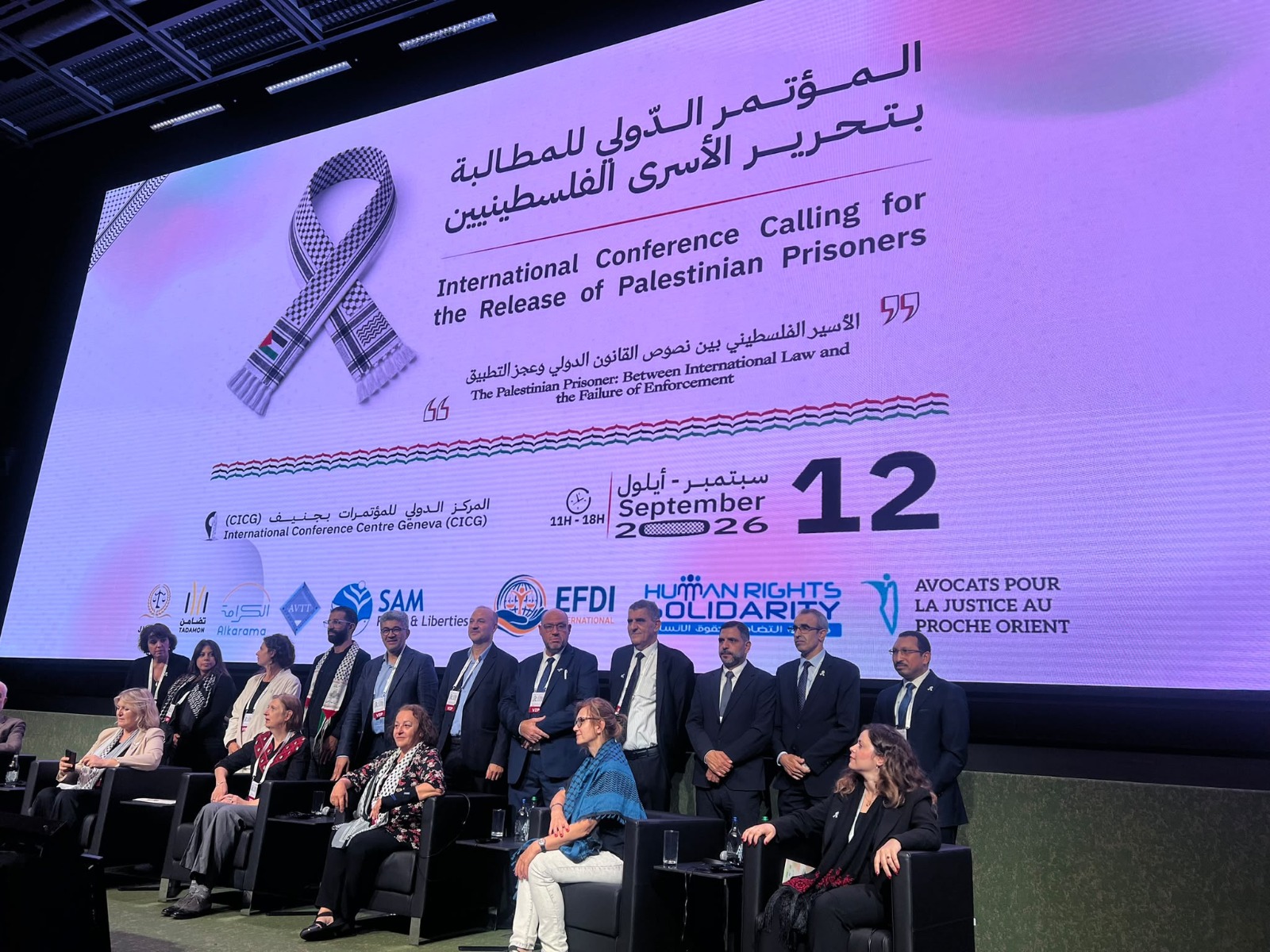
GENEVA — An international conference held on the occasion of Palestinian Prisoners’ Day, titled “The Palestinian Prisoner Between the Text of International Law and the Failure of Its Application,” brought together international lawyers, human rights defenders and representatives of rights organizations in Geneva on September 12, 2026, to discuss the situation of Palestinian prisoners in Israeli jails and the widening gap between the text of international humanitarian law and its enforcement. Speakers ranged from calls to activate legal and economic accountability tools, to firsthand testimony on detention conditions, to warnings that the legal framework itself is being turned into cover for grave violations.
“Not a regional dispute, but a global and human cause”
Opening the conference, Adel Mejri, Secretary-General of the Association of Torture Victims (AVTT), a Geneva-based organization, said the cause of Palestinian prisoners “has never been, and will never be, a mere limited regional dispute, or a local human rights file that ends at a given border” — describing it instead as “a cause of global and human scope.”
Mejri argued that the prisoners’ file amounts to “a real test of the credibility of international law, and of the value of the treaties humanity has agreed on to protect human dignity during occupation and conflict.” He called on activists and human rights defenders to adopt and activate the principle of universal jurisdiction before national courts in different countries, to pursue those directly involved in violations against prisoners.
He also stressed the need to widen the tools available, to include economic accountability — identifying the companies and commercial entities that supply prison authorities with technology or services, and working to hold them accountable before the relevant national and international bodies. He further called for stepping up parliamentary and diplomatic pressure, making use of human-rights clauses in bilateral and regional agreements, and building multilingual digital and legal archives of violations to serve as a lasting reference for accountability efforts.
International justice under pressure
Abdelmajid Mrari, a Moroccan international lawyer who has worked on cases before the International Criminal Court, argued that Israel deals with international law and treaties without genuine commitment, and went further to say that the international justice system itself has come under pressure and retaliation rather than being empowered to pursue perpetrators of violations.
Mrari said that instead of being supported in investigating those accused of committing crimes, the ICC Prosecutor has — in his words — become a target of threats, retaliation and accusations. He pointed to what he described as threats raised during a meeting between the Prosecutor and US Senator Lindsey Graham in April 2024, over the possible issuance of arrest warrants against Israeli officials. Mrari also said one of the Court’s judges had faced similar pressure and threats, and criticized what he called a lack of adequate European response to a report by the Court’s judges that, he said, found no evidence to support the accusations levelled against the Prosecutor.
A humanitarian cause rooted in decades of occupation
Alima Boumediene-Thiery, a French lawyer and former member of the French Senate, said the Palestinian prisoners’ cause is, at its core, a humanitarian one, because it concerns the protection of human beings, their rights, and their right to continue living. She said what is happening today cannot be separated from decades of occupation, arguing that violations against Palestinians and the continued impunity for them stretch back decades and are not simply a product of the events of October 7.
Boumediene-Thiery was critical of the international community’s response, pointing to what she described as states and societies that support, or are complicit with, Israeli policies — complicating, in her view, paths toward accountability and an end to impunity.
Legal action gathering pace across Europe
Julia Fabrier, a lawyer based in Brussels representing an organization she described as working on justice and accountability, outlined a rise in legal action across several European countries in response to violations linked to the occupied Palestinian territories. She pointed to investigations opened in France, Italy, Turkey, Poland and Spain over abuse and torture allegedly suffered by citizens of those countries who took part in the Gaza-bound “Freedom Flotilla.”
She said there are legal demands for states to bar companies and institutions under their jurisdiction from business dealings or partnerships linked to the occupied territories, alongside calls to halt imports of goods originating in settlements, as part of states’ obligations under international law. Fabrier added that a number of countries have already begun taking decisions to stop dealing with settlements, and called for widening accountability to individuals and entities that continue to do business with them, stressing the need for a clear legal framework for corporate-boycott initiatives targeting settlement-linked businesses.
An illegal occupation, and violations that may amount to war crimes
Fabio Marcelli, an Italian international law scholar (formerly a senior researcher at Italy’s National Research Council, ISGI-CNR), argued that the treatment of Palestinian prisoners is among the clearest examples of disregard for international law — locating the problem not in an absence of legal rules, but in the absence of political will among the states responsible for enforcing them. He said public pressure and popular mobilization are essential tools for forcing states to respect international law.
Marcelli cited the International Court of Justice’s 2024 advisory opinion affirming that the Fourth Geneva Convention applies to the occupied Palestinian territories, and noted that the International Committee of the Red Cross continues to treat the West Bank — including East Jerusalem — and the Gaza Strip as occupied territory for the purposes of international humanitarian law. He explained that the law of occupation does not grant an occupying power absolute sovereignty over territory under its control, since occupation under international law is meant to be a temporary status in which the occupying power remains bound by specific obligations toward the population.
He noted the ICJ’s finding that Israel’s continued presence in the occupied Palestinian territories is unlawful, which he said does not relieve Israel of its obligations under international law and the law of occupation. He added that the situation on the ground, in his view, has moved beyond the concept of temporary occupation toward policies of annexation and displacement, and criticized the performance of Israeli courts toward Palestinian prisoners, saying they have failed to provide the protection and justice required under international law.
Marcelli argued that a number of the violations committed against prisoners and detainees may rise to the level of war crimes, citing torture, cruel treatment, the deliberate infliction of severe suffering, unlawful deportation or transfer, and certain forms of unlawful detention. He stressed that responsibility for such crimes is not limited to states, and may extend to individuals, commanders and civilian officials under the rules of international criminal responsibility, warning of an expansion of torture inside detention facilities since October 2023.
“A declared war of extermination inside the prisons”
Raslan Mahajna, a Palestinian lawyer who works full-time on the defense of prisoners, described a sharp deterioration in the conditions of Palestinian prisoners in Israeli jails after October 7, calling what they face “a declared war of extermination inside the prisons.”
He said the restrictions are no longer confined to prisoners themselves, pointing to bans on solidarity demonstrations and a narrowing space for political expression — extending, he said, to legal prosecution of people for writing or speaking about the prisoners’ cause and events in the Palestinian territories.
He described the prisoners’ situation as having reached an extremely harsh level, saying that “death has become a choice for the Palestinian prisoner — perhaps even his preferred choice,” in reference to the severity of the conditions they endure.
Testimony from inside the cells
Khaled Mahajna, another Palestinian lawyer who works full-time defending prisoners, presented a series of accounts he said he had heard directly from detainees during his visits to them inside Israeli prisons, describing what prisoners told him about their conditions as “horrifying.”
According to Mahajna, some prisoners remained handcuffed and shackled for periods of up to three months, and male and female prisoners alike were denied a change of underwear for months at a time. He spoke of the spread of disease among detainees, accusing Israeli authorities of deliberately allowing it to spread.
He also relayed what he described as extremely serious allegations of sexual assault and rape against elderly prisoners, saying that Palestinian, Syrian and Lebanese detainees are subjected, according to their own accounts to him, to brutal methods of abuse inside Israeli prisons — including being forced to leave their cells naked during search operations.
Mahajna said he holds testimony relating to a case of serious sexual assault against an elderly Palestinian prisoner that, he said, ended in the man’s death. He pointed to large numbers of Palestinians for whom, he said, no accurate public information is available regarding their detention since October 7, criticizing the inability of the International Committee of the Red Cross and international and human rights bodies to visit prisoners and inspect their conditions, and saying the isolation imposed on them prevents any independent oversight of what happens inside the prisons.
Citing figures he said he relied on, Mahajna said 51% of prisoners are held without trial or charge, describing them as “hostages and abductees used as bargaining chips.”
From demanding freedom to fearing for life itself
Mahmoud Gaber, a lawyer and director of a human rights organization he described in Arabic as “Justice for Human Rights” (“Adalah” in Arabic — not to be confused with the Haifa-based Adalah Legal Center for Arab Minority Rights in Israel), closed the sessions with an extended address in which he argued that the Palestinian cause “is not a cause that concerns Arabs or Muslims alone,” but a global humanitarian cause touching the core of the right to life and human dignity. “We reject the killing of any human being, regardless of color, sex or faith,” he said, “and above all the Palestinian, who is attacked and finds no one to defend him.”
Gaber addressed Israeli legislation on the execution of Palestinian prisoners, rejecting the idea that it constitutes law in any meaningful sense: “When law turns from a tool that protects human beings into cover for ending their lives, we are looking at the legalization of killing, not the enactment of justice.”
He argued that the danger of this legislation goes beyond the death penalty itself, toward an attempt to give the killing of Palestinians legal and legislative cover, describing the push for the law as an extension of the violations Palestinians have faced since October 7, and insisting the right to life cannot be diminished or made an exception on the basis of identity or nationality.
Gaber cited Article 6 of the International Covenant on Civil and Political Rights, which protects the right to life and prohibits its arbitrary deprivation, noting that Israel is a party to the Covenant. Drawing on roughly a decade of work opposing the death penalty in the Middle East and Africa, he spoke of a serious gap between international commitments and the absence of real accountability, arguing that continued impunity encourages further violations.
After hearing the testimony of lawyers Khaled Mahajna and Raslan Mahajna on prisoners’ conditions, Gaber concluded that the scale of the violations described calls for widening the framing of the cause; the demand, he said, is no longer for the release of prisoners alone, but for protecting the right to life of Palestinians generally — whether held in prison or besieged in Gaza and the West Bank.
Closing his remarks, Gaber called on European states that have abolished the death penalty to take a serious stand against Israel’s prisoner-execution legislation and to work to protect prisoners’ right to life. He proposed that October 10 — the World Day Against the Death Penalty — serve as the next milestone for action following the Geneva conference, calling on the World Coalition Against the Death Penalty to dedicate this year’s occasion to opposing the execution of Palestinians.
Should that proposal not be taken up, he called for establishing a dedicated international coalition of rights organizations, lawyers, judges and defenders of the right to life, alongside launching an international campaign against the execution of Palestinians and against legislation paving the way for it.